Iconic Patterns made with Vietnamese Natural Fiber Weaving Techniques
- Aug 21, 2022
- 3 min read
Updated: Aug 10, 2023
This post is belong to a series of Bong Benh Bay's Circular Design journal.
____
Back in 2020, I didn't know anything about Vietnamese weaving craftsmanship. As I started to dip my feet into researching and developing handicraft products, my mind was broadened in the weaving world. One of the very first things that I learned was the name of iconic weaving techniques and how to classify them.
In this post, I will introduce six main techniques in Vietnamese traditional weaving skills*. Since I am still a learner, this topic may be updated in future posts.
The names of the weaving techniques is used by Viet Trang Handicrafts Manufacturer which based in Thanh Hoa, Northern of the Middle of Vietnam. Therefore, there may be a little different in comparing with other regions.
1, Họa tiết Chấn song / Vietnamese Window pattern – Checkered Pattern
Checkered Pattern has always been well-known in fashion industry. However, in Vietnamese craftsmanship, its name is “Chấn song”, which recall the familiar pattern of window frames. Thanks for its simplicity, the pattern is woven by various of material types such as split seagrass, forward twisted seagrass or palm, and even water hyacinth.


Materials, from left to right: Seagrass, Palm leaves, Water hyancinth
2, Họa tiết Hoa chanh / Lemon Flower pattern – A type of Harlequin Pattern
“Hoa chanh” literally means “lemon flowers”. It is familiar with Harlequin Pattern.
It is usually included two types of fibers having different color to highlight the harlequins. Weavers tend to use seagrass as the structural fibers and water hyacinth or palm leaves as highlight patterns.


Materials, from left to right: Water hyancinth as highlight and Palm leaves as highlights
3, Họa tiết Hoa dâu / Strawberry Flower Pattern – Diagonal Stripes
“Hoa dâu” can be translated as “strawberry flowers”. It is an apple of my eyes since the first day I learned about the swatches. The pattern successfully performs a visual trick which surprises the eyes every time we look at it from different perspective. This pattern is often made by plaiting seagrass fiber and palm leaf fiber.


Materials: Palm leaves and seagrass
4, Họa tiết Xương cá - Herringbone Pattern
Herringbone is a popular pattern in different fiber industries. The name isn’t changed much in Vietnamese since we call it “xương cá” – fishbones. It is also known as one of the most complex weaving techniques among Vietnamese traditional villages. Back then, it requires a gathering of all the villages’ residents in Nga Son every time they got orders of herringbone seagrass rugs.


Materials: Water hyacinth woven as herringbones
5, Họa tiết Chuồng gà – Hexagon Pattern
Developed from an agricultural background, Vietnamese often built working terms by using the names of daily things. Just like that, weavers call hexagonal patterns as “chuồng gà” because the motifs mostly appear in henhouse.


Materials: Seagrass
6, Họa tiết Mắt na/ Hạt gạo – Custard Apple Seed Pattern/ Rice Pattern
The Rice pattern is seen in water hyacinth woven products thanks to its simplicity and its fit with the material. This weaving technique helps in making soft surface whether it is on a handbag or the seating part of a pouf.
In this laundry basket, the lower part is woven in Rice Pattern technique.


Materials: Water Hyancinth
Combination
Each material and weaving technique can bring a different feature to the table. As creative as our weavers, they always attempt to combine basic weavings to create something novel and fresh. Although my role is designer, I have always been surprised by their constructive nature whenever they suggest using a brand new combination of motifs.


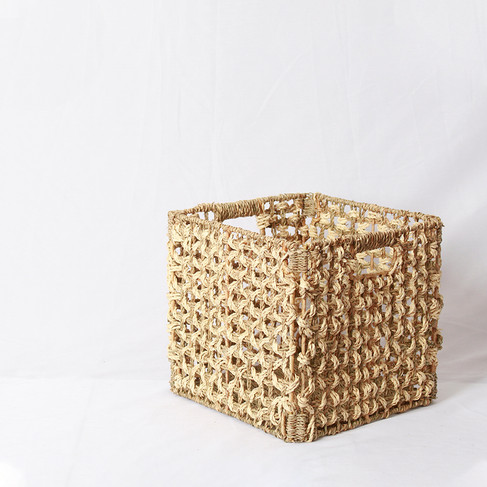
Materials: Water hyacinth with Palm leaves coiled around
In conclusion, to designers who are finding their way to woven handicrafts, I hope this post finds you well and gives you an encouraging boost on your learning path.
____
*: All the product images used in this writing come from the collections: Foldable Baskets, Mindful Living, and Sowl - Woven Planters, which I developed for Viet Trang in 2021 and 2022.


Comments